Turning waste into high worth - sustainably
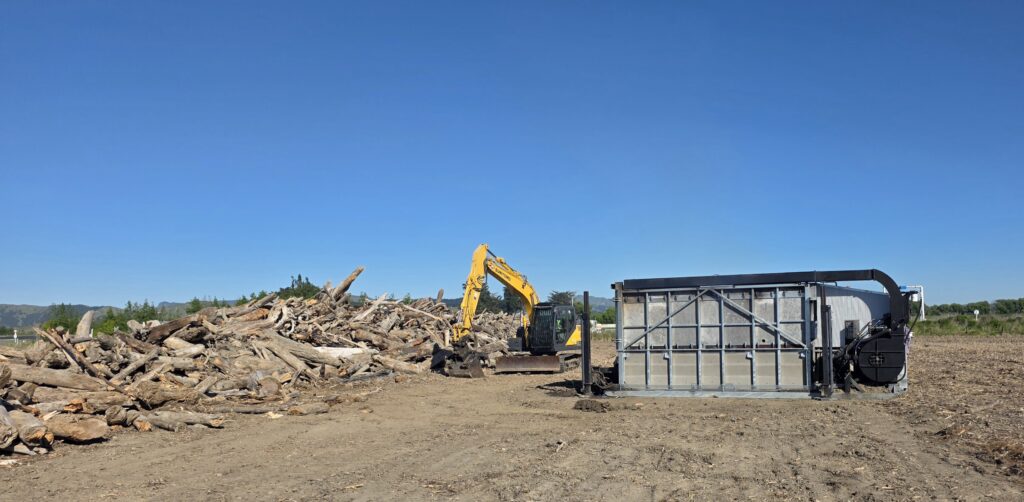
Charcurtain Machine
A practical way to deal with slash, wilding pines at source, and unlock new income
WHY THE CHARCURTAIN?
1. Eliminate Pre-Processing Costs
Stop wasting time and money on carting and chipping. The Charcurtain accepts raw feedstock—including pine, slash, and bulky green waste—in its natural form, up to 5m in length.
- Continuous Feed: Process up to 6 tonnes per hour.
- Moisture Ready: Handles variable moisture levels without stalling production.
- Fully Mobile: Designed for easy deployment to forestry sites or waste facilities.
2. High-Value Output: Biochar
The Charcurtain isn’t just an incinerator; it’s a production plant. At a 10% yield, every hour of
operation produces roughly 600kg of high-quality Biochar.
- Proven ROI: With Biochar valued at ~$5,000/tonne in NZ, selling at even a
conservative $1,000/tonne yields over $1M in annual net revenue (based on 50
hrs/week for 42 weeks).
3. Reflective Heat Technology
Our thick, firebox-lined walls reflect intense heat back into the core. This “oven effect” ensures that the fuel is gasified and decomposed with maximum efficiency, accelerating the
conversion to char.
ENVIRONMENTAL INTEGRITY
Unmatched Environmental Performance Traditional open burning is dirty, slow, and increasingly restricted. The Charcurtain utilizes a high-velocity air manifold to create a “lid” across the top of the fire, trapping smoke and particulates.
Clean Burning Data Our system operates as a high-performance pollution control device.
Based on established Air Curtain Incinerator (ACI) emission factors:
” The Charcurtain achieves a secondary burn at approximately 1,100°C, effectively gasifying smoke and particulates. This results in an 80-90% reduction in Particulate Matter () compared to open-pile burning.”
Metric Performance Data
Combustion Temp 1,100°C (Secondary Burn)
Opacity < 10% (Virtually invisible emissions)
Particulate Matter 0.24 – 1.3 lb/ton (Industrial-leading standard)
CO Emissions 2.2 – 2.6 lb/ton (Indicates complete combustion)
What is an Air Curtain burner?
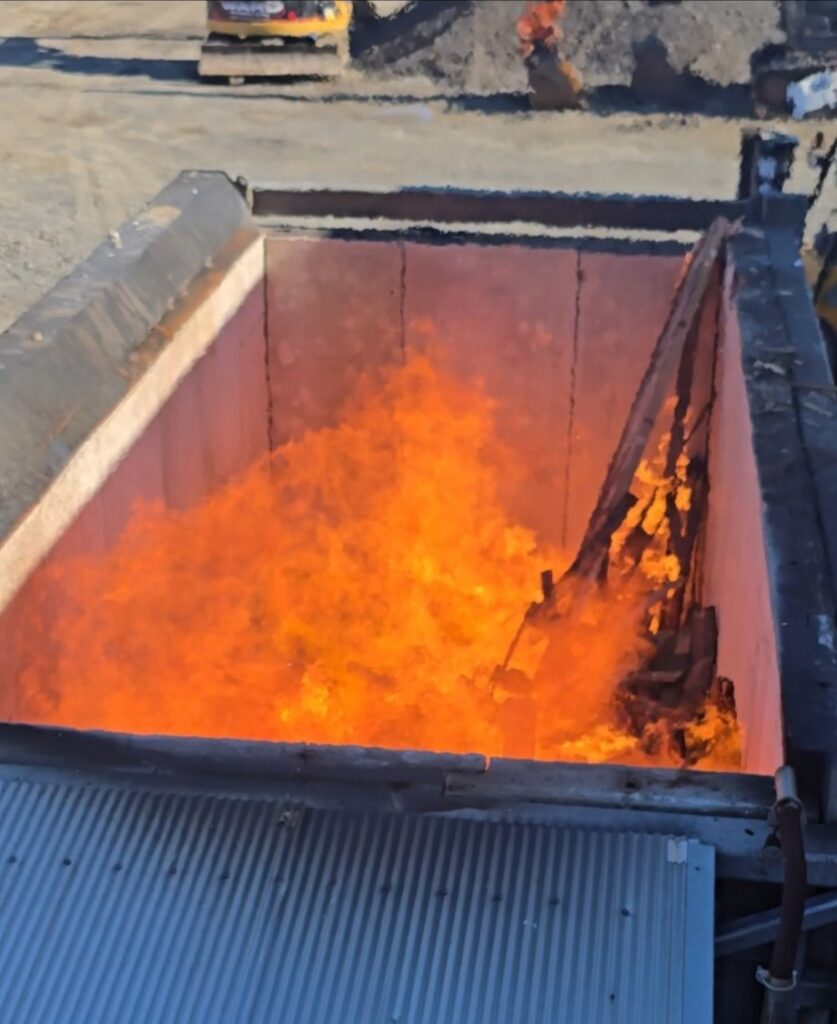
A highly efficient combustion system designed to cleanly and quickly dispose of wood waste and forestry slash in a safe, contained environment, with minimal smoke and emissions.
Purpose: To ‘pyrolyse’ large volumes of vegetative waste (like logs, branches, stumps, and slash) cleanly, efficiently, and on-site, without any preprocessing.
- Burns biomass at high temperatures – up to 1,100◦c
- Uses a curtain of air across the top of the burn chamber to:
Keep heat in, eliminate smoke and manage a complete combustion
- A clean, fast, and portable method of woody waste disposal
- Produces a valuable product called Biochar – about 8% of input
HOW IT WORKS
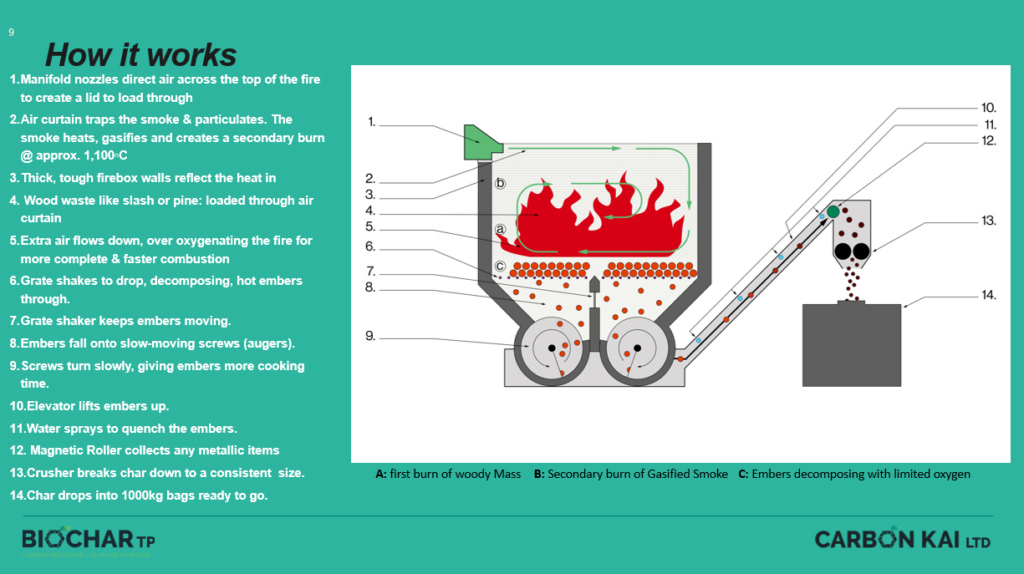
The 14-Step Precision Process
- Air Lid: Manifold nozzles create a high-velocity air curtain.
- Smoke Trap: Particulates are trapped and re-burned at 1,100°C.
- Reflective Walls: Firebox walls reflect heat inward for faster combustion.
- Direct Load: Feed raw wood waste directly through the air curtain (up to 5m).
- Over-Oxygenation: Extra air flows down to ensure complete combustion.
- Agitated Grate: Shaking grates drop hot, decomposing embers.
- Active Movement: Grate shaker prevents clogging and keeps embers moving.
- Auger Delivery: Embers fall onto slow-moving screws.
- Controlled Cooking: Screws turn slowly to allow char to reach the perfect consistency.
- Elevator: Lifts the finished char out of the burn chamber.
- Quenching: Water sprays stop the combustion, locking in the carbon.
- Metal Recovery: A magnetic roller removes any metallic contaminants.
- Sizing: A crusher breaks the char down to a consistent, marketable size.
- Bagging: Final product is dropped into 1,000kg bags, ready for sale.
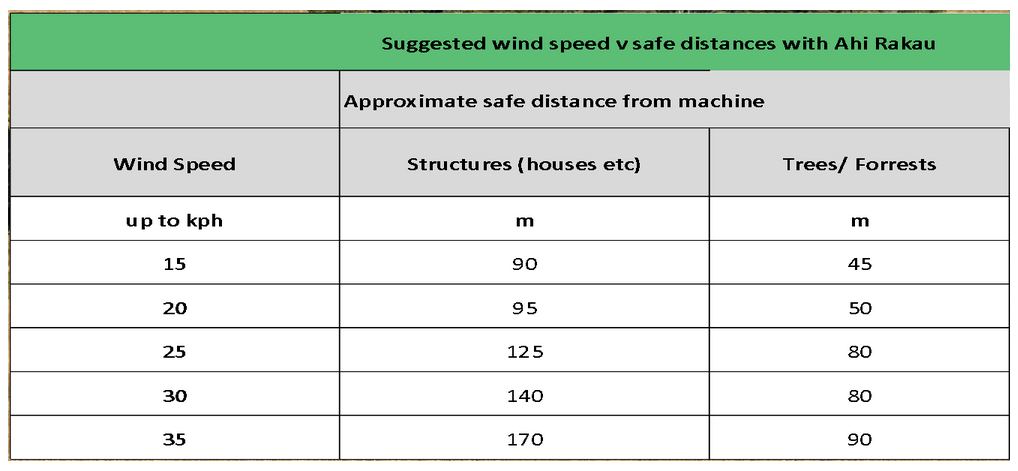
Safe Operating Conditions